
Benoît B. Mandelbrot

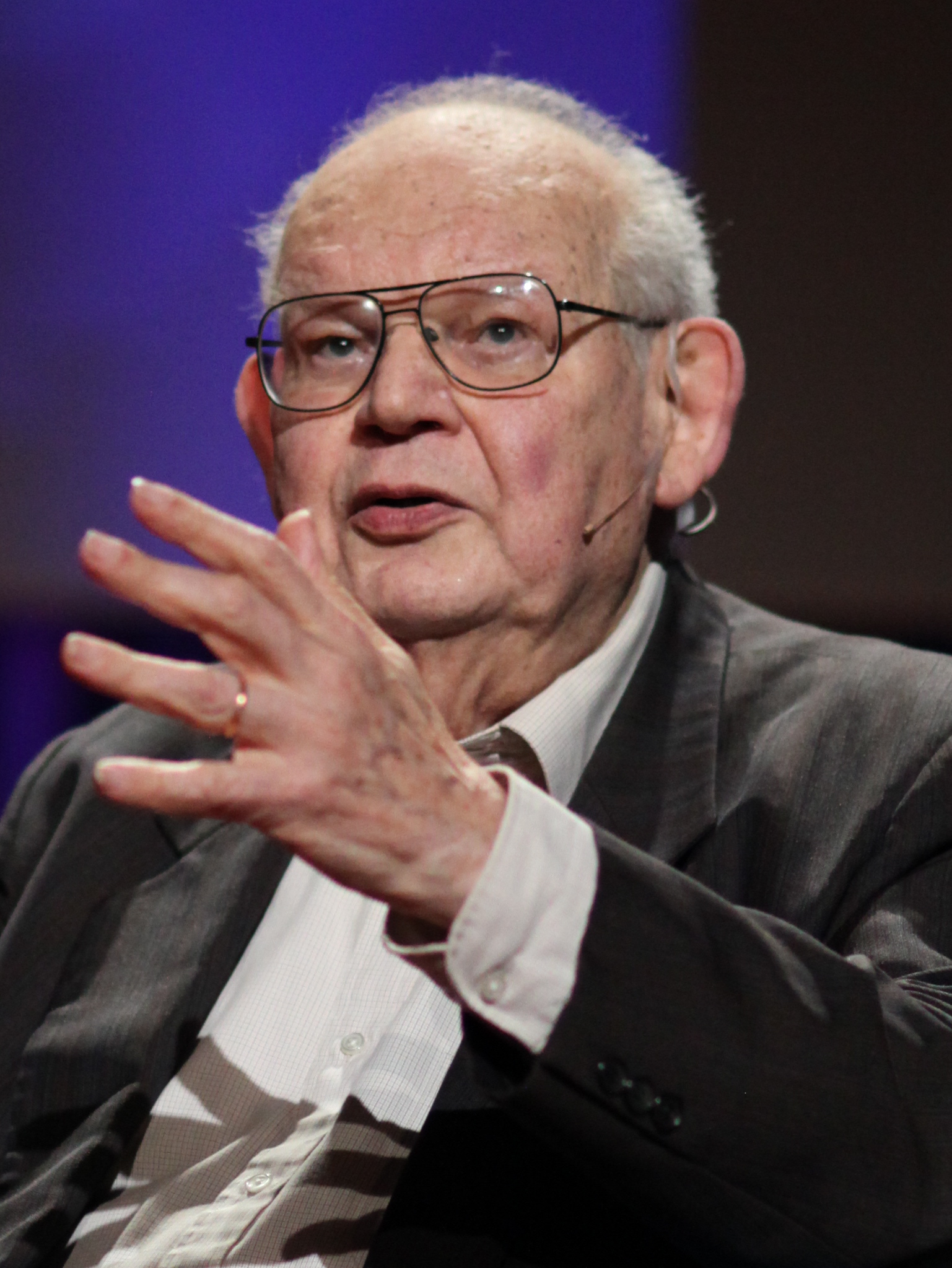
- (b.) 1924 November 20 - (d.) 2010 October 14
Bio/Description
Discoverer of the Mandelbrot set of intricate, never-ending fractal shapes — said to be "one of the most astonishing discoveries in the entire history of mathematics" — Mandelbrot also developed a "theory of roughness" in nature and the field of fractal geometry, which included coining the word "fractal." He was a Polish-born French and American mathematician. Mandelbrot was born in Warsaw, Poland, to a Jewish family that had a strong academic tradition and was first introduced to mathematics by two of his uncles, one of whom, Szolem Mandelbrojt, was a mathematician who resided in Paris. In his autobiography he states, "The love of his mind was mathematics."
The family emigrated from Poland to France in 1936 when he was 11. He attended the Lycée Rolin in Paris until the start of World War II, when his family then moved to Tulle, France. He was helped by Rabbi David Feuerwerker, the Rabbi of Brive-la-Gaillarde, to continue his studies. In 1944, he returned to Paris and studied at the Lycée du Parc in Lyon, and from 1945 to 1947 attended the École Polytechnique, where he studied under Gaston Julia and Paul Lévy.
From 1947 to 1949 Mandelbrot studied at California Institute of Technology, where he earned a Master's degree in Aeronautics. Returning to France, he obtained his Ph.D. degree in Mathematical Sciences at the University of Paris in 1952. He spent most of his career in both the U.S. and France, having dual French and American citizenship. From 1949 to 1958, he was a staff member at the Centre National de la Recherche Scientifique.
During this time he spent a year at the Institute for Advanced Study in Princeton, New Jersey, where he was sponsored by John von Neumann. In 1955 he married Aliette Kagan and moved to Geneva, Switzerland, and later to the Université Lille Nord de France. In 1958 the couple moved to the United States, where Mandelbrot joined the research staff at the IBM Thomas J. Watson Research Center in Yorktown Heights, New York. He remained at IBM for 35 years, becoming an IBM Fellow and later Fellow Emeritus.
From 1951 onward, he worked on problems and published papers not only in mathematics but in applied fields such as information theory, economics, and fluid dynamics. Because of his access to IBM's computers, he was one of the first to use computer graphics to create and display fractal geometric images, leading to his discovering the Mandelbrot set in 1979. By doing so, he was able to show how visual complexity can be created from simple rules. He said that things typically considered to be "rough," a "mess," or "chaotic," like clouds or shorelines, actually had a "degree of order."
As a visiting professor at Harvard University, Mandelbrot began to study fractals called Julia sets that were invariant under certain transformations of the complex plane. Building on previous work by Gaston Julia and Pierre Fatou, he used a computer to plot images of the Julia sets. While investigating the topology of these Julia sets, he studied the Mandelbrot set fractal that is now named after him. In 1982, he expanded and updated his ideas in The Fractal Geometry of Nature, an influential work that brought fractals into the mainstream of professional and popular mathematics, as well as silencing critics who had dismissed fractals as "program artifacts."
His research career included contributions to such fields as geology, medicine, cosmology, engineering, and the social sciences. Science writer Arthur C. Clarke credited the Mandelbrot set as being "one of the most astonishing discoveries in the entire history of mathematics." Mandelbrot found that price changes in financial markets did not follow a Gaussian distribution, but rather Lévy stable distributions having theoretically infinite variance. He found, for example, that cotton prices followed a Lévy stable distribution with parameter α equal to 1.7 rather than 2 as in a Gaussian distribution. "Stable" distributions have the property that the sum of many instances of a random variable follows the same distribution but with a larger scale parameter.
He created the first-ever "theory of roughness," and he saw "roughness" in the shapes of mountains, coastlines, and river basins; the structures of plants, blood vessels, and lungs; and the clustering of galaxies. His personal quest was to create some mathematical formula to measure the overall "roughness" of such objects in nature. He began by asking himself various kinds of questions related to nature, such as: "Can geometry deliver what the Greek root of its name [geo-] seemed to promise—truthful measurement, not only of cultivated fields along the Nile River but also of untamed Earth?"
Mandelbrot left IBM in 1987, after 35 years and 12 days, when IBM decided to end pure research in his division. He joined the Department of Mathematics at Yale and obtained his first tenured post in 1999, at the age of 75—the oldest professor in Yale's history to receive tenure. At the time of his retirement in 2005, he held the position of Sterling Professor of Mathematical Sciences. He also held positions at the Pacific Northwest National Laboratory, Université Lille Nord de France, Institute for Advanced Study, and Centre National de la Recherche Scientifique.
Called a visionary and a maverick, his informal and passionate style of writing and his emphasis on visual and geometric intuition—supported by the inclusion of numerous illustrations—made his book The Fractal Geometry of Nature accessible to non-specialists. The book sparked widespread popular interest in fractals and contributed to chaos theory and other fields of science and mathematics. During his career, he received over 15 honorary doctorates and served on many science journals, along with winning numerous awards. His autobiography, The Fractalist, was published in 2012.
Mandelbrot also put his ideas to work in cosmology. He offered in 1974 a new explanation of Olbers' paradox (the "dark night sky" riddle), demonstrating the consequences of fractal theory as a sufficient, but not necessary, resolution of the paradox. He postulated that if the stars in the universe were fractally distributed (for example, like Cantor dust), it would not be necessary to rely on the Big Bang theory to explain the paradox. His model would not rule out a Big Bang, but would allow for a dark sky even if the Big Bang had not occurred.
His awards included the Wolf Prize for Physics in 1993, the Lewis Fry Richardson Prize of the European Geophysical Society in 2000, the Japan Prize in 2003, and the Einstein Lectureship of the American Mathematical Society in 2006. The small asteroid 27500 Mandelbrot was named in his honor. In November 1990, he was made a Knight in the French Legion of Honour, and was promoted to Officer of the Legion of Honour in January 2006. In December 2005, he was appointed to the position of Battelle Fellow at the Pacific Northwest National Laboratory. An honorary degree from Johns Hopkins University was bestowed on him in the May 2010 commencement exercises.
Citations:
-
Date of Birth:
1924 November 20 -
Date of Death:
2010 October 14 -
Gender:
Male -
Noted For:
Discoverer of the Mandelbrot set of intricate, never-ending fractal shapes, said to be “one of the most astonishing discoveries in the entire history of mathematics” -
Category of Achievement: