
Conel Hugh O'Donel Alexander, CMG, CBE

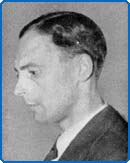
- (b.) 1909 April 19 - (d.) 1974 February 15
Bio/Description
One of the key workers on breaking the Enigma machine, Alexander made vital contributions to British codebreaking during World War II. An Irish-born British cryptanalyst, chess player, and chess writer, he was born in Cork, Ireland, the eldest child of an engineering professor at University College, Cork. His father died in 1920, and the family moved to Birmingham in England, where he attended King Edward's School. He won a scholarship to study mathematics at King's College, Cambridge in 1928, graduating with a first in 1931. From 1932, he taught mathematics in Winchester, and in 1938 he left teaching and became head of research at the John Lewis Partnership.
In February 1940, Alexander arrived at Bletchley Park, the British codebreaking centre during World War II. He joined Hut 6, the section tasked with breaking German Army and Air Force Enigma messages. In 1941, he transferred to Hut 8, the corresponding hut working on Naval Enigma, becoming deputy head under Alan Turing. He was more involved with the day-to-day operations of the hut than Turing, and he formally became the head of Hut 8 around November 1942, while Turing was visiting the United States. Other senior colleagues included Stuart Milner-Barry, Gordon Welchman, and Harry Golombek. In October 1944, he was transferred to work on the Japanese JN-25 code.
In mid-1946, Alexander joined GCHQ (under the control of the Foreign Office), which was the post-war successor organization to the Government Code and Cypher School (GCCS) at Bletchley Park. GCHQ was a British intelligence agency responsible for providing signals intelligence (SIGINT) and information assurance to the UK government and armed forces. By 1949, he had been promoted to the head of "Section H" (cryptanalysis), a post he retained until his retirement in 1971, having served there for over 20 years.
MI5's Peter Wright, in his 1987 best-selling book "Spycatcher: The Candid Autobiography of a Senior Intelligence Officer", wrote about Alexander's assistance to MI5 in the ongoing Venona project, as well as other important mutual cooperation between the two organizations, which broke down previous barriers to progress. "Any help is gratefully received in this department," he told Wright, and that proved the case from then on. Wright also lauded his professionalism, and opined that the exceptional mental demands of Alexander's cryptanalytical career and chess hobby likely contributed to his early death at age 64, despite his healthy lifestyle.
He represented Cambridge University in the Varsity chess matches of 1929, 1930, 1931, and 1932. He was twice a winner of the British Chess Championship, in 1938 and 1956, and represented England in the Chess Olympiad six times, in 1933, 1935, 1937, 1939, 1954, and 1958. At the 1939 Olympiad in Buenos Aires, Argentina, he had to leave part-way through the event, along with the rest of the English team, because of the declaration of World War II, as he was required at home for codebreaking duties. He was also the non-playing captain of England from 1964 to 1970, and was awarded the International Master title in 1950 and the International Master for Correspondence Chess title in 1970.
Alexander won Hastings 1946/47 with the score 7½/9, a point ahead of Savielly Tartakower. His best tournament result may have been first equal (with David Bronstein) at Hastings 1953/54, where he went undefeated and beat Soviet grandmasters David Bronstein and Alexander Tolush in individual games. His opportunities to appear abroad were limited, as he was not allowed to play chess in the Soviet bloc because of his secret work in cryptography. He was also the chess columnist of The Sunday Times in the 1960s and 1970s.
Many knowledgeable chess people believed that he had Grandmaster potential, had he been able to develop his chess abilities further. Many top players peak in their late twenties and early thirties, but for Alexander this stretch coincided with World War II, when high-level competitive opportunities were unavailable. After this, his professional responsibilities as a senior cryptanalyst limited his top-class appearances. He defeated Mikhail Botvinnik in one game of a team radio match against the Soviet Union in 1946, at a time when Botvinnik was likely the world's top player. He made important theoretical contributions to the Dutch Defence and Petroff Defence.
In "Turing's Cathedral" by George Dyson, Alexander is quoted as saying, "When the war started probably only two people thought that the Naval Enigma could be broken," (from an internal history written at the end of the war) "Birch [his boss] thought it could be broken because it had to be broken and Turing thought it could be broken because it would be so interesting to break it." According to Alexander, Turing explained his interest as follows: "No one else was doing anything about it and I could have it to myself." It is noted that, "Breaking the naval Enigma to reveal the locations of the U-boats that were crippling the British supply lines was critical to keeping England afloat."
Citations:
-
Date of Birth:
1909 April 19 -
Date of Death:
1974 February 15 -
Gender:
Male -
Noted For:
One of the workers on the Enigma machine -
Category of Achievement: