
Donald Peter Greenberg

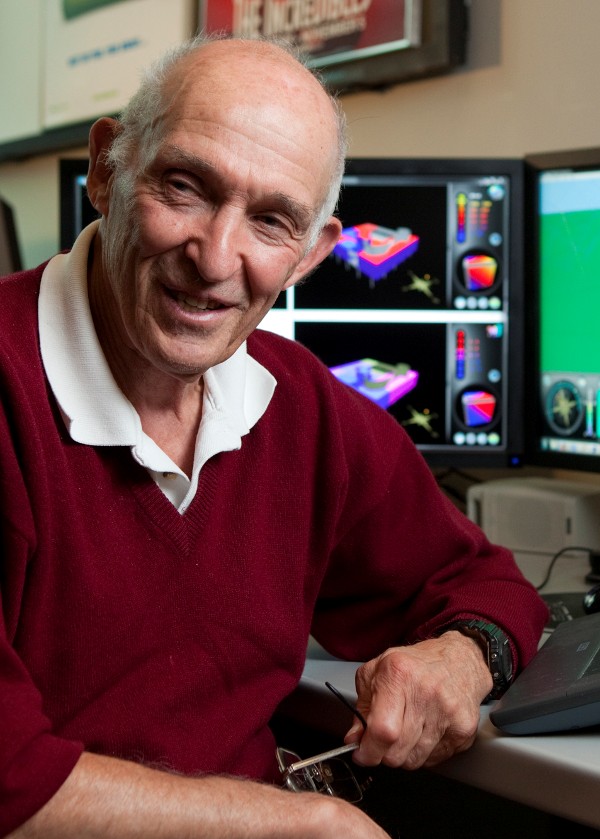
- (b.) 1934
Bio/Description
Pioneer developer of software that influenced many architectural software (CAAD) products still in use today, Greenberg also initiated the first computer-aided architectural design studio in the United States in 1984. An internationally recognized pioneer in computer graphics, he has authored hundreds of articles and, from 1966 onward, has served as a teacher and mentor to many prominent computer graphic artists and animators. Five former students won Academy Awards for Scientific or Technical Achievements, five won the SIGGRAPH Achievement Award, and many went on to work for Pixar Animation Studios. His former students included Robert L. Cook, Marc Levoy, and Wayne Lytle.
He has served as the founding Director of the National Science Foundation Science and Technology Center for Computer Graphics and Scientific Visualization when it was created in 1991. Prior to teaching at Cornell, he worked as a consulting engineer with Severud Associates, working on famous structures like the St. Louis Arch and Madison Square Garden.
The Jacob Gould Schurman Professor of Computer Graphics at Cornell University in Ithaca, New York, he earned his undergraduate and Ph.D. degrees from Cornell, where he played on the tennis and soccer teams and was a member of Tau Delta Phi and the Quill and Dagger society. Greenberg joined the Cornell faculty in 1968 with a joint appointment in the College of Engineering and College of Architecture. His early software developed at Cornell influenced the development of many architectural software (CAAD) products still in use today. He has served as Director of the Program of Computer Graphics.
In the late 1960s, he constructed the "flying diaper" sculpture, which stood at the entrance of the Cornell Plantations. In 1971, Greenberg produced an early sophisticated computer graphics movie, Cornell in Perspective, using the General Electric Visual Simulation Laboratory with the assistance of its Director, Quill and Dagger classmate Rodney S. Rougelot. He also co-authored a series of papers on the Cornell Box, a test aimed at determining the accuracy of rendering software by comparing the rendered scene with an actual photograph of the same scene, and it became a commonly used 3D test model.
He received the ACM SIGGRAPH Steven Anson Coons Award in 1987 for Outstanding Creative Contributions to Computer Graphics. It is the most prestigious award in the field of computer graphics. In addition, Greenberg was the recipient of the 1989 NCGA Academic Award (the highest educational award given by the National Computer Graphics Association). He has served as a visiting Professor at ETH Zurich and Yale University, and has sat on the board of Directors of the Interactive Data Corporation and Chyron Corporation.
He holds membership in the National Academy of Engineering, American Association for the Advancement of Science, Association for Computing Machinery, Institute of Electrical and Electronics Engineers, SIGGRAPH, and Eurographics. Greenberg was named a fellow of the Association for Computer Machinery (ACM) in 1995. He has authored hundreds of articles on computer graphics, including two published in Scientific American in May 1974 and February 1991, both of which were highly publicized, and he has lectured extensively on the uses of computer graphics techniques in design and research applications.
His more recent computer graphics research projects have remained concerned with the goal of creating images that are physically accurate and perceptually indistinguishable from real-world scenes. His work has focused on algorithms for realistic image generation, the development of new methods for representing surface reflections and methods for their validation, and the modeling of physically accurate light sources, both artificial and the solar sky domes. Greenberg led a major, multi-million dollar Department of Energy research project for developing techniques for sustainable design in architecture. Emphasis was placed on the development of graphical input and output methods, the improvement of the accuracy of the energy simulation programs, and the use of graphics algorithms to accelerate the computation.
Citations:
-
Date of Birth:
1934 -
Gender:
Male -
Noted For:
Pioneer developer of software that influenced the development of many architectural software (CAAD) products still in use today - initiator of the first computer-aided architectural design studio in the U.S. in 1984 -
Category of Achievement: