
Marsha J. Berger

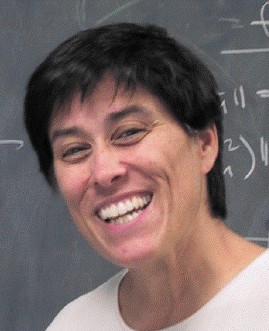
Bio/Description
Pioneer of adaptive mesh refinement (AMR) and Cartesian mesh finite difference methods for numerical PDEs, Berger's block-structured AMR approach, beginning with her thesis, is now considered one of the seminal ideas in numerical PDEs.
She earned her B.S. in Mathematics at SUNY-Binghamton, and an M.S. in Computer Systems and a Ph.D. in Numerical Analysis at Stanford University in 1982. From 1982 onward she held several positions at the Courant Institute of Mathematical Sciences, beginning as a Post-Doctoral Fellow. She joined the faculty in 1985 and became a full Professor of Computer Science in 1993. Berger has also served as a visiting scientist at RIACS/NASA Ames Research Center from 1991.
Drawing heavily on the areas of computer science, numerical analysis, and applied mathematics, her interdisciplinary research deals in scientific computing with an application to fluid dynamics, and she has worked closely with aerodynamicists at NASA. She was elected to the prestigious National Academy of Sciences in 2000. Among her many honors are the NASA Software of the Year Award, the NYU Sokol Faculty Award in the Sciences, the NSF Faculty Award for Women, and the NSF Presidential Young Investigator Award. She has also served on the Board of Governors of the Institute of Mathematics and its Applications.
There are at least two major pieces of her work that demonstrate significant contributions. The first is adaptive mesh refinement (AMR); the block-structured approach that Berger pioneered, beginning with her thesis, is now considered to be one of the seminal ideas in numerical PDEs. She developed high-performance versions of the method for unsteady compressible flow, parallel versions of AMR, a steady flow version of AMR, and a number of algorithmic innovations. Her work became the basis for a large number of activities around the world in developing adaptive methods.
A second area where she made a very substantial and important contribution was in Cartesian mesh finite difference methods for numerical PDEs in complex geometries. Berger made a number of significant contributions in the design of consistent algorithms for this approach. In addition, she made a major breakthrough with Melton and Aftosmis on the generation of the Cartesian grid descriptions given the specification of the geometry as a surface triangulation.
Geometry, not physics, has been the main obstacle in engineering fluid computations. The principal difficulty in engineering calculations in numerical PDEs is generating the grid, a process that can take months. With Cartesian grid methods the time was drastically reduced to a few minutes on high-end workstations. To achieve this required some very subtle constructions from computational geometry and the judicious use of adaptive precision floating point calculations.
Berger is a consistently creative and productive scientist working in a large and intensely competitive field — applied numerical PDEs. Her success has been achieved by a combination of clever and insightful ideas for approaching the problems, plus meticulous attention to detail in the execution. Her work is considerably more than the sum of the parts and has had a profound impact on her field. Berger is a scientist with considerable technical skills and accomplishments, as well as vision and leadership in her field.
Citations:
-
Gender:
Female -
Noted For:
Developer of high-performance versions of the method for unsteady compressible flow, parallel versions of AMR, a steady flow version of AMR, and a number of algorithmic innovations which is the basis for a large number of activities around the world in developing adaptive methods; and developer of Cartesian mesh finite difference methods for numerical PDE's in complex geometries -
Category of Achievement: