Heinrich Rudolf Hertz
Honorees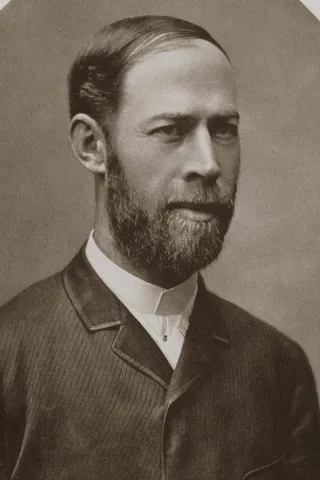
The first to satisfactorily demonstrate the existence of electromagnetic waves, Hertz clarified and expanded the electromagnetic theory of light that had been put forth by Maxwell. He was born in Hamburg, Germany, and while studying at the Gelehrtenschule des Johanneums in Hamburg, he showed an aptitude for sciences as well as languages, learning Arabic and Sanskrit. Hertz studied sciences and engineering in the German cities of Dresden, Munich, and Berlin, where he studied under Gustav R. Kirchhoff and Hermann von Helmholtz.
In 1880, he obtained his PhD from the University of Berlin and remained for post-doctoral study under Hermann von Helmholtz. In 1883, he took a post as a lecturer in theoretical physics at the University of Kiel, and in 1885, he became a full professor at the University of Karlsruhe, where he discovered electromagnetic waves. His experiments would later trigger the invention of the wireless telegraph, radio, and later television.
Hertz was the first to satisfactorily demonstrate the existence of electromagnetic waves by building an apparatus to produce and detect VHF or UHF radio waves. In 1886, he developed the Hertz antenna receiver, a set of terminals that is not electrically grounded for its operation. He also developed a transmitting type of dipole antenna, which was a center-fed driven element for transmitting UHF radio waves. These antennas are the simplest practical antennas from a theoretical point of view.
His research from his days as a lecturer, preceding his great work on electromagnetism—which he himself considered with his characteristic soberness to be trivial—has come down to the age of nanotechnology. In bulk, his experiments explained reflection, refraction, polarization, interference, and velocity of electric waves. Hertz's discoveries would later be more fully understood by others and became part of the new "wireless age."
In recognition of his work, the unit of frequency—one cycle per second—is named the "hertz." The SI unit hertz (Hz) was established in his honor by the IEC in 1930 for frequency, a measurement of the number of times that a repeated event occurs per second (also called "cycles per sec" (cps)), and it was adopted by the CGPM (Conférence générale des poids et mesures) in 1964. Among other honors bestowed upon him is a crater that lies on the far side of the Moon, just behind the eastern limb, which was named in his honor.
Citations: