July 16, 2026 Alan Weissberger
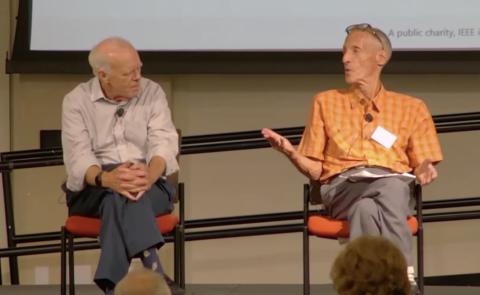
On October 8, 2025, John Hennessy, the MIPS co-founder, RISC pioneer, past President of Stanford University, and Chairman of Alphabet, sat down for a 95-minute conversation at Santa Clara University, moderated by Alan J. Weissberger for the IEEE Silicon Valley community. The full video is on YouTube. What the video cannot capture is what the moderator was thinking. Alan spent more than 50 years in the industries the conversation covered: microprocessors at National Semiconductor and Signetics, consulting for AT&T Bell Labs, and five decades of telecom and networking. We sent him questions about the discussion; his answers appear below. Each section links to the moment in the video it responds to.
"Just for hobbyists": how the microprocessor was underestimated
ITHS: When Professor Hennessy arrived at Stanford in 1977, you had been the applications engineering manager for National Semiconductor's microprocessor group from 1973-1976 and in the Signetics Microprocessor Applications Group at Signetics. You said at that time "the word on the street was microprocessors are for embedded logic." Did anyone around you at the time foresee microprocessors displacing the rest of the computer industry? (watch from 2:05)
Weissberger: No! In 1977, when asked what he thought of MOS LSI microprocessors in PCs, the Signetics Microprocessor Software Engineering Manager said, "those are just for hobbyists."
It was strongly believed in 1976-1978 that bipolar bit slice processors (e.g. AMD 2900) and bipolar semiconductor memory would be used in minicomputers as well as for high speed real time embedded logic. MOS LSI Microprocessors remained singularly focused on embedded logic applications until IBM's first PC which was announced in August 1981. My Northeastern University MSEE classmate Dave House convinced IBM to use the Intel 8088 in their first PC. Dave coined the phrase "Intel inside"
Editor's note: Intel's official history credits the "Intel Inside" campaign (1991) to marketing executive Dennis Carter, whose team created the earlier tagline "Intel, the computer inside." House has recounted shortening it: "I wrote 'Intel Inside' and put a circle around it and said that's better" (EE Times; Intel Virtual Vault).
When the center of gravity moved west
ITHS: Hennessy recalled that in the late 1970s, "if you wanted to talk to the movers and shakers in the computer industry, you got on a plane and you flew to New York or you flew to Boston." When, in your view, did the center of gravity shift to Silicon Valley? (watch from 6:11)
Weissberger: Hennessy meant that you flew to the Boston area to talk with minicomputer makers like DEC, Data General, Honeywell, Prime, etc. and to NY to talk to IBM. However, there were several minicomputer makers in Orange County CA (Computer Automation, General Automation and Microdata) + HP in Palo Alto, CA.
The center of gravity for microprocessors to be used in computers didn't come until Intel transitioned from a semiconductor memory company to a full fledged microprocessor company with the release of the Intel 80386 in 1985. The 80386 extended the x86 architecture to 32-bits, allowing multitasking.
Gordon Bell, Jim Clark, and the founding of MIPS
ITHS: Hennessy credits Gordon Bell with convincing him to start MIPS, on the grounds that the technology was "too disruptive" for incumbents to adopt on their own. You knew Gordon Bell. Does that advice sound like him, and was he right about the incumbents? (watch from 8:51)
Weissberger: Not entirely correct. Hennessy suggested the main reason to start MIPS was that the technology was too revolutionary to be in the research stage without a startup pushing it into the market. In his oral-history-style remarks, he says Bell urged him to start a company because otherwise the ideas would just "sit on the shelf," and Hennessy later characterized the business pitch as "this technology was so revolutionary it was going to sweep over the industry eventually." Hennessy also said it was "naive" to assume computer industry incumbents would read published RISC papers and implement the idea, and he described the industry as hesitant even years later. His Stanford University office mate Jim Clark influenced Hennessy indirectly, by making entrepreneurship feel like a normal Stanford-to-startup path rather than an exceptional leap of faith. So the MIPS founding story centers on the technical opportunity, Gordon Bell's encouragement, Jim Clark's entrepreneurship example and the belief that the RISC ideas needed a startup to reach the market.
Reference: https://www.youtube.com/watch?v=Vy35wFqa8kY
Separately, Gordon Bell was much more influential in convincing Len Shustek to start the Computer History Museum. I've interviewed Len, got him to present at various Jewish and IEEE events + lead a SCU student tour of the CHM. He is one of my personal heroes- as noted below.
What cloud engineers should learn from timesharing
ITHS: During the discussion you described cloud computing as "the reinvention of time sharing (e.g. Telenet and Tymnet)," because computer and storage resources are rented- not owned. What should today's cloud engineers learn from the timesharing era that they may not know? (watch from 30:39)
Weissberger: Today's cloud engineers should learn that the hardest problems are often operational, not just technical. Those include: scheduling/orchestration, customer work job isolation, fairness, accounting, reliability, and protecting users from outages, surprise cost or capacity changes. The timesharing era solved many of the same challenges under a different name, and its history is a good reminder that "renting compute" creates both convenience and new forms of lock-in. Timesharing showed that shared IT infrastructure only works well when the platform makes strong guarantees about multiplexing, security, and responsiveness across many users. It also taught that utilization gains are real, but they do not eliminate the need for skilled operators; they change the operator's job from running one machine to managing a service ecosystem.
A lot of today's cloud computing/storage culture assumes the main innovation is abstraction, but the timesharing era shows that abstraction without governance eventually becomes a cost and control problem. Shared IT systems become valuable only when they make the invisible visible: utilization, contention, privilege boundaries, and chargeback. Cloud engineers should design for serviceability, not just elasticity. An important time sharing lesson is that renting compute power is easy to sell, but hard to sustain unless the IT platform is predictable, reliable, and accountable over the long run.
Bell Labs then, hyperscaler labs now
ITHS: Hennessy observed that Bell Labs, Xerox PARC, and IBM Research were "research labs for the country," made possible by monopolies, and that today's model is different but "I don't know that it's better or worse." Having consulted for Bell Labs yourself, how would you compare the two eras? (watch from 37:45)
Weissberger: In the mid to late 1980s-early 1990s my biggest consulting clients were AT&T Bell Labs, Bell Northern Research and BellCore. I will focus on AT&T Bell Labs, which did pure research aimed at expanding knowledge as well as project-driven research aimed at solving AT&T's immediate and future telecom problems. That mix was possible because Bell Labs sat inside a regulated monopoly with stable funding, a deep in-house engineering base (in Holmdel, NJ and Naperville, IL), and a long planning horizon tied to the telephone network. The pure side mattered because it created the intellectual raw material for later systems: theory, devices, algorithms, and methods that were not always tied to a product deadline. The project side mattered because it forced the lab to turn ideas into working infrastructure, which kept research grounded in deployment reality.
Today, almost all scientific/engineering research is done by hyperscalers that don't do pure research or anything remotely close to it. Instead, their research is tightly coupled to product cycles, platform economics, and competitive differentiation. Even when they publish open research, much of it is aimed at improving cloud services, ads, AI models, data centers, developer tools, or security rather than pursuing open-ended inquiry for its own sake. Why pure research is no longer common in hyperscalers is mostly about incentives and structure. Public companies face quarterly pressure, so long-horizon work has to justify itself through near- or medium-term business value; unlike AT&T Bell Labs, there is usually no monopoly-era subsidy protecting curiosity-driven work.
In addition, hyperscalers can buy external innovation quickly through start-up acquisitions, partnerships, open-source ecosystems, and academic collaborations, which makes internal basic research easier to cut or narrow when budgets tighten. For example, Amazon acquired Annapurna Labs, an Israeli microelectronics company, in 2015. It serves as Amazon Web Services' (AWS) in-house semiconductor division, responsible for designing Amazon's proprietary AI chips (such as Trainium and Inferentia). The world's #1 cloud computing company also acquired Perceive - an edge chip and AI model compression company (a subsidiary of Xperi) for $80 million in August 2024 to boost its on-device and edge computing capabilities.
The important nuance is that hyperscalers do still do research, but it is usually mission-linked research, not AT&T Bell Labs-style industrial science with a large protected pure-research frontier. So the real difference is not "research vs no research," but "research as a durable institutional purpose" versus "research as a strategic support function." Also, the Nokia Bell Labs "research" is more product focused than ever with many employees part of design project teams.
Judging the moonshots: a Waymo rider's view
ITHS: Regarding Google's moonshot projects, Hennessy said, "It says moonshot. It doesn't say every single one is successful." How should history judge investments like Waymo? (watch from 42:45)
Weissberger: Very, very few "moonshot" projects are successful. Google Gemini says, "Approximately 2% of experimental projects at Alphabet's X (the moonshot factory) successfully graduate into independent companies or core products. X CEO Astro Teller has noted that maintaining this low graduation rate is intentional, as the lab focuses on ruthlessly testing wild ideas and celebrating failures early."
Notable Successes & Spinouts:
- Waymo: The autonomous driving division, which successfully spun out as an independent Alphabet subsidiary.
- Wing: A drone delivery service that graduated from the lab.
- Verily: Alphabet's life sciences organization focusing on precision health.
- Anori: A recent spinout leveraging AI to streamline building approvals and construction.
Graduations to Google. Some projects don't leave the Alphabet ecosystem but instead "graduate" directly into Google itself. Key examples include:
- Google Brain: The deep-learning foundation that currently powers Google's AI models.
- GCam: The computational photography software used in Google Pixel phones.
The "Fail Fast" Philosophy. The remaining 98% of projects are eventually discontinued, repurposed, or shut down.
High-profile closures include Project Loon (internet-beaming balloons), Makani (energy kites), and Mineral (AI for agriculture). Alphabet utilizes a dedicated spinout fund, Series X Capital, to help de-risk and fund the few concepts that make the cut.
Waymo has been a commercial success. It's already moved autonomous driving from "science project" into a real commercial service, with paid rides in multiple U.S. cities and large-scale operational deployment. My friend and I rode a Waymo from my home in Santa Clara to Mt. View and back. It was a very comfortable, smooth ride. Waymo helped define the technical and regulatory baseline for robotaxis, improved safety expectations, and forced competitors and regulators to treat autonomy as an operating reality rather than a demo. Also, spin-outs may follow, like simulation pipelines, safety systems, map making and operational know-how that might be reusable across products and successor teams.
Where AI's real risks lie
ITHS: Hennessy said he is "not a gigantic believer" in existential risk from AI, with the exception of autonomous weapons, where he called for international agreements comparable to those against poison gas and biological weapons. What is your own assessment of where AI's real risks lie? (watch from 44:12)
Weissberger: As AI has become so pervasive, the risks are everywhere and enormous. As its compute power increases with each AI model release, the risks increase exponentially. While I use it every day to research topics for IEEE Techblog posts, I am terrified by its potential to destroy humanity as we now know it. The risks are too many to enumerate. Suggest you ask your favorite AI agent to identify them.
Conversely, I am very frustrated by the idiotic answers and AI hallucinations I get on my Google for Home and Alexa+ "smart" (really DUMB) speakers every day. I've had to disconnect both repeatedly to preserve my sanity.
Where he would place Hennessy's "if I knew" investment
ITHS: Hennessy noted that general-purpose processor performance gains have fallen from 50% per year to 5 or 10%, and said of the next architectural breakthrough, "If I knew the answer to that question, I'd be investing in it." Where would you place that investment? (watch from 87:55)
Weissberger: As I've been mostly involved in telecom/networking and semiconductors for the past 50 years, I would restrict my investments to those 2 fields.
- For telecom, I see big potential in all aspects of Non Terrestrial Networks for both LEO satellite internet and Direct-to-Device (D2D), also known as Direct-to-Cell, a satellite communication technology that allows standard consumer smartphones and IoT devices to connect directly to satellites without needing any specialized hardware, external antennas, or bulky satellite hotspots. Essentially, it turns low-Earth orbit (LEO) satellites into "cell towers in space" to eliminate cellular dead zones across the globe.
- The most promising new semiconductors in the next few years are the ones that will solve bottlenecks in power, memory bandwidth, interconnect, and specialized AI compute. In practical terms, that means advanced-node logic, HBM4-class memory, advanced packaging/chiplets, silicon photonics/co-packaged optics, and wide-bandgap power devices are the areas most likely to matter most commercially. I'm especially drawn to semiconductors that can reduce power consumption/dissipation which continues to be a huge problem with GPU based AI hardware.
It's surprising that despite the initial hype over 5G and now 5G advanced/6G, there are ONLY 2 merchant 5G endpoint semiconductor companies- Qualcomm and MediaTek (Taiwan). So I would not invest in any start-up pursuing 6G which won't be commercially available until 2031 at the earliest.
Superstars and Unsung Heroes of the Valley
ITHS: Hennessy's Silicon Valley icons were Teresa Meng, Gordon Moore, and Steve Jobs. Having lived in Santa Clara for more than 55 years, who would be on your list, particularly people whose contributions are underappreciated? (watch from 47:48)
Weissberger: Actually, I've lived in the city of Santa Clara for 56+ years and came to town when this area was called "the valley of heart's delight" because its main output was agriculture.
Here's my list of contemporary Silicon Valley superstars:
- Bob Noyce & Gordon Moore: co-founders of both Fairchild and Intel that gave rise to the semiconductor industry in Silicon Valley.
- Steve Jobs: incredible product vision at Apple which resulted in the Macintosh PC, iPod, and iPhone. Those permanently altered consumer technology and made Apple the world leader, surpassing Japan Inc.
- Larry Page & Sergey Brin: the Stanford PhD students who co-founded Google (neither completed their PhD studies).
- Bob Metcalfe: made 10 Mb/sec Ethernet the IEEE 802.3 LAN standard and a commercial success at Xerox and 3Com. He was greatly assisted by my late best friend Ron Crane RIP, who designed the analog portion of the world's first 10Mb/sec Ethernet card for the Xerox Star 8010 workstation in 1977-1978 and also designed 3Com's hugely successful Etherlink card for the IBM PC in 1981.
- Jensen Huang: Co-founder and CEO of Nvidia. By shifting focus to GPUs, he positioned his company to provide the essential underlying processing hardware powering modern global AI clusters. Incredible insight, focus and anticipation of IT industry trends.
Unsung Heroes are too many to mention. Here are the individuals that most greatly shaped my career in Silicon Valley:
- Professor Tim Healy: my supervisor & mentor when I was an EECS grad school faculty member. Together we defined the grad EECS telecom curriculum for MS and PhD students.
- Suhas Patil: founder of Cirrus Logic and creator of the world's first Silicon Compiler that enabled fabless semiconductor companies and created the Electronic Design Automation (EDA) industry.
- Rob Walker, RIP: applications engineering manager at Fairchild, then worked at Intel and later co-founded LSI Logic Corporation. In a continuing education class at SCU, Rob taught me how to design combinational and sequential digital logic using MSI circuits.
- Len Shustek: co-founder and chairman of the Computer History Museum (now in Mt View, CA) who inspired me to learn about the history of computing.
- Ted Hoff: inventor of the microprocessor at Intel who encouraged me to create the IEEE Silicon Valley History committee in 2013 which I chaired till 2015 and was active till my Oct 8, 2025 conversation with Prof. Hennessy. Ted participated in many IEEE panel sessions I organized and moderated.
"Way, way too much power": can startups still win?
ITHS: In closing the session, you said the greatest risk to Silicon Valley today is "concentration and dominance," with cloud hyperscalers holding "way, way too much power." What would need to change for startups and new innovation to thrive? (watch from 94:34)
Weissberger: The cloud hyperscalers each have their own proprietary ecosystems and supply chains. They do everything themselves - from designing hardware and software to making semiconductors to building subsea cable systems for inter continental connectivity. There are very few exit strategies for tech start-ups today, other than to be acquired by a hyperscaler. For startup innovation to thrive, they would need: easier access to capital, more talent mobility, less dependency on a few dominant cloud and AI platforms, and a culture that values long-term product quality instead of pure hype. More open infrastructure would surely help. Startups need portable cloud, data, and AI stacks so they can switch providers without rebuilding everything; that reduces lock-in and frees them to compete on product, not infrastructure dependency. Startups thrive when the market allows multiple winners, especially in AI, cloud, and developer tools, instead of forcing everyone into a hyperscaler's platform-led business model and IT system. That's not possible today, because each cloud provider has their closed walled garden/IT stack/proprietary APIs.
I don't see the needed changes coming anytime soon, which means that most innovation will come from within hyperscaler research labs rather than tech startups.
Alan J. Weissberger, ScD EE, organized and moderated the October 8, 2025 conversation with Professor Hennessy for the IEEE Santa Clara Valley section. He founded the IEEE Silicon Valley Technology History Committee in 2013 and is content manager of the IEEE ComSoc Technology Blog. Watch the full conversation, including Q&A with the audience, on YouTube.