November 5, 2026 Nicola Marras
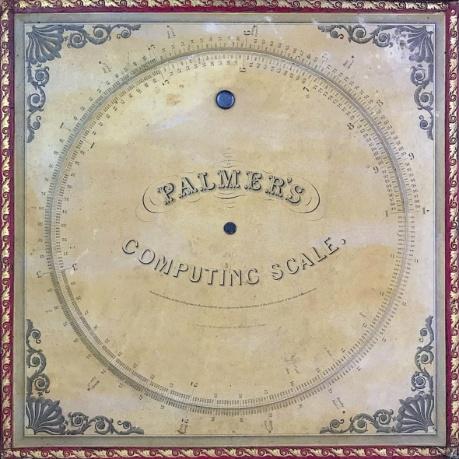
«An application of American Genius to a British Principal»— Palmer’s Scale ad, 1852
Until 1880, slide rules were not widely used in the USA. A small number were imported from France, England, and Germany—the leading manufacturing countries. It was not until around 1890 that Keuffel & Esser, based in New York, began marketing a model of its own.
Nevertheless, there exists an earlier example of an entirely American slide rule, which reached the market in 1844. As J. E. Thompson notes in his Manual of the Slide Rule:
“One of the earliest slide rules produced in America was the Palmer’s Computing Scale, which appeared in Boston in 1844. It was later modified and carried all the usual scales of that time but seems not to have been used outside of Massachusetts and New York.”
Florian Cajori, in an article from 1909, also states:
“Palmer’s instrument is of special interest to Americans because it is one of the first, if not the first, slide rule that was designed, manufactured, and sold in the United States.”
With a later edition, which included the Fuller’s Telegraph Computer, for the first time the title of computer was attributed to a tool rather than a person. Historically, this word served strictly as a job title for humans performing manual calculations. However, according to L.C. Karpinski, with the marketing of this device it began to be attributed to calculators.
These slide rules are printed on 11-inch square heavy cardboard, featuring a rotating cardboard disc at the center, secured by a brass pin. A small bronze knob is attached to the edge, allowing the disc to be rotated. They include the standard logarithmic C and D scales and brief instructions for use printed on the back.
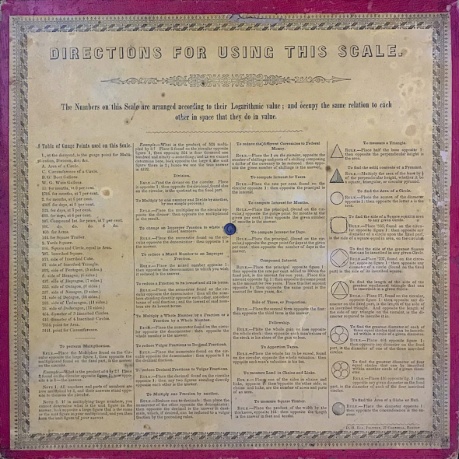
The back of the first edition of 1844, with the directions for use (image by www.followingtherules.info)
History
Information on the history of this calculator is very scarce, so I shall attempt to gather it from available texts and the examples I’ve seen.
At the beginning of 1842, Mr. Palmer exhibited the first prototype of his calculator, and the following year he obtained a copyright for it. Also in 1843, he copyrighted the first edition of the instruction booklet, titled Key to Palmer’s Computing Scale.
Sales began in 1844, but only a few copies were released. A second, corrected issue appeared just a few months later. The instruction booklet was now titled Palmer’s Pocket Scale and included a reduced-size version of the original slide rule. This new booklet was published in Boston in 1844-45 and then in Rochester in late 1845.
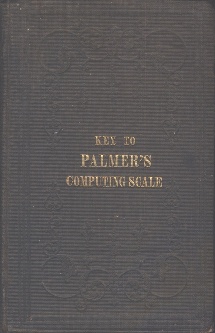
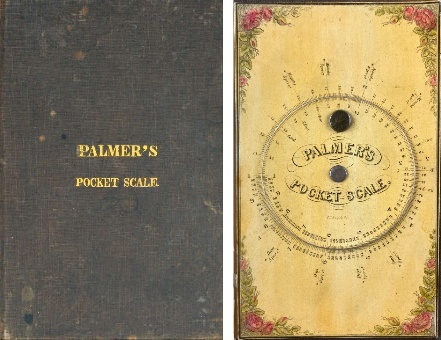
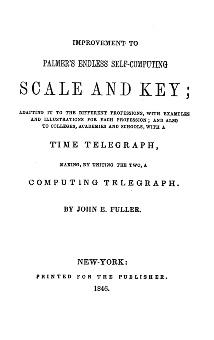
The booklets of the first, second, and third-fourth issues—only the second includes, on its final page, a reduced-scale replica of the main slide rule (images: eBay listing; booklet scans from archive.org, Wikimedia Commons, and Google Books)

In 1845, Mr. Palmer entered into a partnership with Mr. John E. Fuller, and in 1846 they introduced an improved version. On the reverse side, there is now a second circular scale—a non-logarithmic one called Fuller Time Telegraph—designed to determine the number of days between two dates.
This issue has a cover containing the instructions on the inside page, includes an Analytical Table of Mechanical Movements, and the booklet is now named Key to Fuller’s Computing Telegraph. Two more editions followed, apparently with minor changes in the booklet, and production ceased around 1870. Approximately 10,000 units were sold.
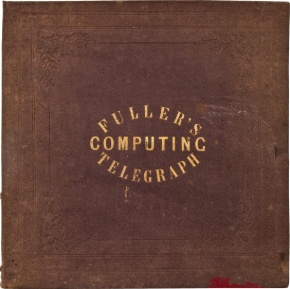
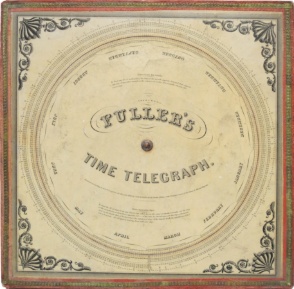
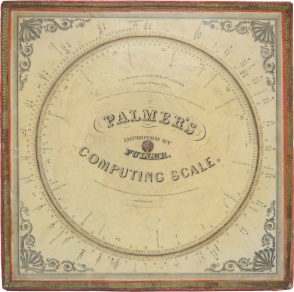
Cover of the third issue, Fuller Time Telegraph, and new Palmer’s Scale (images: Christie’s and The Map House)
Buyer’s guide
- Issue I, 1844: The instructions contain approx. 1,300 words, and their left column contains a list of thirty-two gauge points. Note on the front the inscription “Engraved by George G. Smith 186 Washington St. Boston”, absent from subsequent editions. The instruction booklet is the Key to Palmer’s Computing Scale, Boston, 1844.
- Issue II, 1844–45: The scales remain unchanged, but the instructions have been expanded to approx. 2,100 words, and their left column now features only a list of eighteen gauge points. The instruction booklet is the Palmer’s Pocket Scale, Boston, 1844, or Rochester, 1845.
- Issue III, 1846: The slide rule is now enclosed between two covers that contain the instructions, and it has the Time Telegraph affixed to the back. The scale side of this version features forty-seven gauge points. The instruction booklet is the Key to Fuller’s Computing Telegraph, New York, 1846.
- Issue IV, 1847–60: The cover remains the same, but the Computing Scale now features the inscription “Improved by Fuller” around the center pin, along with the instruction “use the inner circle for dollars, cents and mills” on the upper portion. The copyright date has been updated to 1847, and the scale side now has fifty-seven gauge points. The instruction booklet is the same of the previous issue, but later examples were published in 1851.
- Issue V, 1848: Designed for the British market, it can be identified by the inscription “use the inner circle for dollars, cents and mills or Pounds, Shillings, & Pence” on the upper portion of the computing scale. Nothing else is known about this version, and one can only assume that the instruction booklet remained largely the same, with only minor modifications.
- Late issues: After 1860, it was advertised for sale exclusively via subscription as Telegraphic Computer. No information is available beyond this date, although Florian Cajori maintains that it remained in production for many more years.
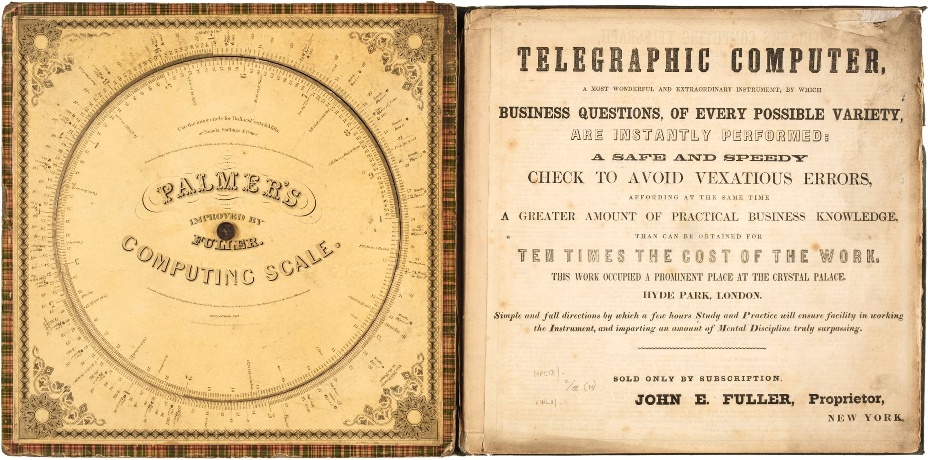
Computing Scale and Telegraphic Computer (image by www.dominicwinter.co.uk)
Verdict and pricing
It is astounding that a few examples of this cardboard-constructed calculator can still be found on the market. In fact, very few have survived and prices—depending on their condition or the outcome of an auction—range from $700 to $1,800, regardless of whether it is the first model or a later version. A fair price is around $1000-1200.
Prices for the instruction booklets also vary significantly, sometimes very high; however, it is reasonable to pay a max of $450 for the I and II versions and $550 for the III and IV.
A collection of mathematical instruments should include the first American slide rule—ideally the first edition. The model improved by Fuller is also of interest; it is also worth seeking out the accompanying instruction booklet, which is almost never found together with the slide rule itself.
I certify that this work was written entirely by a human without the use of generative AI tools.
Bibliography
- Cajori, Florian, Aaron Palmer’s Computing Scale and John E. Fuller’s Circular Slide Rules, Colorado College Publication, Engineering Series 1, June 1909.
- Cajori, Florian, A History of the Logarithmic Slide Rule and Allied Instruments, New York, 1909.
- Feazel, Bobby, Palmer’s Computing Scale, JOS 4.1, 1995.
- www.followingtherules.info.
- Fuller’s Computing Telegraph, The Public Ledger, St. John’s, Newfoundland, August 11 1857.
- Fuller, John, Key to Fuller’s Computing Telegraph, New York, 1846.
- Fuller, John, Fuller’s Computing Telegraph, Issue 5, Hartford, 1847.
- Karpinski, L.C., Bibliography of Mathematical Works through 1850, University of Michigan Press, Ann Arbor, 1940, pp. 471-2.
- Palmer, Aaron, Key to the Endless Self Computing Scale, Boston, 1844.
- Palmer, Aaron, Palmer’s Pocket Scale, Rochester, 1845.
- Scientific American, Vol. 1, Issue 8, October 16 1845.
- The Eighteenth Annual Fair of the American Institute, American Whig Review, No. 5, 1845.
- Thompson, J.E., Manual of the Slide Rule, New York, 1930.