Articles
Showing 25 articles by Paul Ceruzzi
September 23, 2008
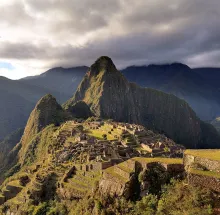
Not Quite Machu Picchu, but Close.
I have a close relative who’s traveled the world. She’s climbed Mt. Kilimanjaro. She rode on a dilapidated bus through the Khyber Pass, on her way to India along the famous “Hippie Trail." She visited Machu Picchu and taught at a school in East Africa. Even though my work involves travel, I am an...
July 23, 2008
Music
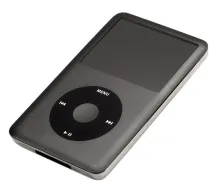
All three of my kids have iPods. One of them has a model that holds 10,000 songs. If each song were, on average, about three minutes long, it would take two months to get through them all, if you listened to the gadget for 8 hours a day. What’s the point? At the dawn of the Information Age, a...
July 2, 2008
LEO was the first WHAT?
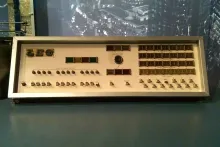
The first business computer. The first Systems Analyst. As a curator, I always demur when asked "what was the first....?" There's no end to it, and technology does not proceed that way. A new technology does not suddenly appear in fully functional form; it "eases up" to functionality. At some point...
June 27, 2008
SAGE and the Origins of Modern Computing
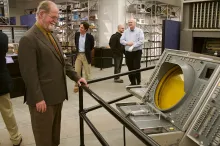
An old, rare IBM film about SAGE recently surfaced on YouTube -- what a fantastic resource that web site is. The film brought back many discussions I've had with my colleagues about the place of SAGE in the history of computing. Paul Edwards saw SAGE as the centerpiece of the "Closed World" of...
June 18, 2008
Two Dispatches from the U.K.
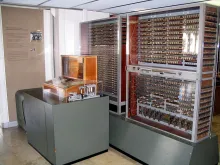
Despite my dissertation research on Konrad Zuse, I've been accused of a bias toward the American side of computer history. Here are a couple of news items from the U.K. that may offset that. The first concerns what may be the first recording of music generated by a computer--the Manchester "Baby,"...
June 13, 2008
Moore's Law Again, and a (Possibly) Naked Emperor
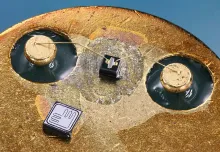
In an earlier post (March 20), I discussed Moore’s Law and its relation to the history of computing. Once again I feel compelled to return to the topic—this time, to discuss its impact, not on computer science and technology, but on its historians. Put simply, historians of technology, including...

May 21, 2008
History of Computing — the View from Montana
In an earlier post I mentioned the American Computer Museum of Bozeman, Montana. You can look at its web site for details. Now that the weather is getting warm, it is time for all of us who are interested in computing history to figure out a way to get to Bozeman and see it. You don't really need...
May 5, 2008
Science Fiction, Science Fact, and the Future of Computing
Last February I had the privilege of attending a conference on “Imagining Outer Space,” held in Bielefeld, Germany. I have been to many conferences on the history of rocketry and space travel, and on the social and cultural implications of the Space Age, but none of them were as stimulating as this...

April 16, 2008
What we don't know
An obituary in a recent Washington Post brought back a flood of memories for me, and reminded me of a topic I had been meaning to discuss but had put aside. Samuel S. Snyder is a name that should be familiar to many historians of computing—he authored an article on “Computer Advances Pioneered by...
April 4, 2008
"Cybernetics is the Universal Solvent of Technology"
Those words were spoken by the late Professor W. David Lewis, of Auburn University, discussing a talk I had given about the relationship of computing to aerospace. We all know the corollary: if you discover a universal solvent, in what container can you hold it? For myself, working at the National...
March 26, 2008
Moore's Law, Steve Case, and YouTube
Moore’s Law is an empirical observation—that the density of computer memory chips doubles about every 18 months, and it has been doing so for the past four decades. Magnetic storage capacity, and to a less-regular extent, processor speeds and telecommunications bandwidth have also been increasing...
March 10, 2008
An Alternative Universe
Within the past decade, the cell phone has spread around the world. The iPod is a permanent appendage to teen-agers, while the Blackberry plays the same role for "grown-ups." All these, of course, are based on the microprocessor, whose architecture in turn is based on computer designs that go back...