Articles
Showing 103 articles
September 30, 2014
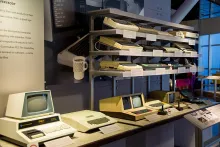
Computer History Museum: Celebrating 35 Years: Sept 26,2014
Introduction: The Computer History Museum (CHM) marked its 35th birthday on September 24, 2014. Visitors from around the world see an impressive set of exhibits, artifacts and come for the conversations, panel sessions and lectures. One such panel took place on Sept 26th, with CHM co-founders...
September 25, 2014
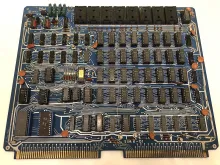
Ted Hoff: Significant Omissions from Malone's Intel Trinity Book
Written by Ted Hoff, PhD and edited by Alan J. Weissberger Please refer to earlier post on Errors and Corrections to Malone's book. General omission: Malone omits why I was hired at Intel as I was not a chip designer. The reason was Bob Noyce's view that LSI circuits were moving in the direction...
September 12, 2014
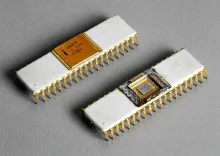
Ted Hoff: Errors & Corrections in Intel Trinity book by Michael Malone
Editor's NOTE: This article was written by Ted Hoff, PhD EE and edited by Alan J. Weissberger, Chairman of the IEEE SV History Committee. From Ted Hoff: The errors listed below are in approximately the same order as they appear in Malone's book. To aid the reviewer, chapters are identified in...
September 9, 2014
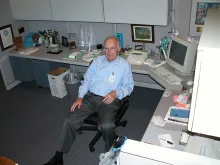
Author Michael Malone at the Commonwealth Club: The Story Behind Intel
On August 6, 2014, Michael Malone, Author of The Intel Trinity, spoke at the Commonwealth Club of Silicon Valley. The program was held in the upper galleries of the Tech Museum in San Jose, CA. Similar to his earlier speech at the Computer History Museum, Mr. Malone emphasized the evolution,...
September 8, 2014
The Evolution of the Desk
A group of students at the Harvard Innovation Lab have created a time-lapsed visualization of the impact of computers, IT, and technology on our lives. The video provides a historical review of the office desk, beginning from the 1980s all the way to present day. The opening scene introduces a desk...
September 2, 2014
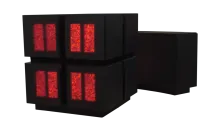
Bloodless Beige Boxes | The Story of an Artist and a Thinking Machine
When was the last time you walked into a data center and were stopped dead in your tracks by the beauty of a computer? Right, probably never. That is why you will most likely never see a computer in any art history books...but there is one that may well change that. Even though there is amazing...
June 30, 2014
DARPA Director Arati Prabhakar in Conversation with John Markoff @CHM June 11, 2014
Introduction: This CHM conversation (with NY Times moderator John Markoff asking the questions) was more about the challenges faced by Ms Arati Prabhakar, PhD than it was about DARPA. It would've been very appropriate for a Women in Engineering meeting. However, there were several important...
April 7, 2014
Happy 50th Birthday S/360!
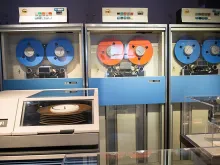
I consider this set of 150 products announced on April 7, 1964, to be the most important introduced by an American company in the 20th century. And I am not alone in that view. How we used computers around the world was shaped directly by these machines and software, including your cell phone....
March 10, 2014
The New Digital Age: Authors Eric Schmidt and Jared Cohen in Conversation with Facebook’s Sheryl Sandberg at CHM
Introduction: On March 3, 2014, Eric Schmidt and Jared Cohen (co-authors of The New Digital Age) engaged in a stimulating conversation with Facebook's COO Sheryl Sandberg. The event took place at the Computer History Museum (CHM) as part of the museum's Revolutionary series (see description...
February 24, 2014
A Billion Programmers
When I first wrote programs in 1953, there was no software and few programmers. I entered programs in the computer’s binary language (octal notation) directly into the machine’s registers. And the machine was all mine: there was no operating system to allocate its resources among multiple programs...
January 22, 2014
Approved IEEE Milestone: Birth of the 1st PC Operating System (CP/M)
Introduction: Gary A. Kildall, PhD (1942 – 1994), developed and then demonstrated the first working prototype of CP/M (Control Program for Microcomputers) in Pacific Grove in 1974. Together with his invention of the BIOS (Basic Input Output System), Kildall’s operating system allowed a...
January 21, 2014
Why Care Who Invented the First Computer?
During January some of you might have noticed a running dialogue among historians and other interested parties about who invented the “first” computer. There was no agreement reached on the correct answer to that question. Discussions about “firsts” pop up about every five years, almost like...