
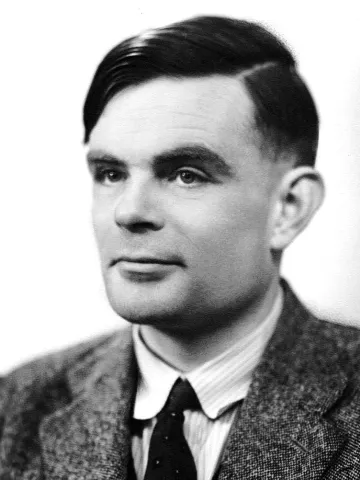
The mathematical logician Alan Mathison Turing OBE (1912-1954) contributed to logic, mathematics, cryptanalysis, philosophy, mathematical biology, and formatively to computer science, Artificial Intelligence, cognitive science, and the computational study of biological growth.
Turing was elected a Fellow of King’s College Cambridge in 1935, and in 1936 published his most important work, ‘On Computable Numbers, with an Application to the Entscheidungsproblem’. In this he described his—soon to be highly influential—formal model of computation, the Turing machine. He also proved the existence of uncomputable or unsolvable mathematical problems, including the Hilbertian Entscheidungsproblem (decision problem). From 1936–1938 Turing studied for a PhD at Princeton University, returning to King’s College in 1938. His PhD dissertation ‘Systems of Logic Based on Ordinals’ was published in 1939; in it he explored the implications of Gödelian incompleteness, and did pioneering work in what would become the core area of computability theory called degree theory. At the outbreak of war with Germany (September 1939) Turing moved from Cambridge to Bletchley Park, the wartime headquarters of the Government Code and Cypher School (GC & CS). Here he broke Naval Enigma, and was principal designer of the anti-Enigma Bombe, an electromechanical computing machine that implemented what is now called heuristic search. Turing also devised the first systematic method for breaking the momentous ‘Tunny’ messages—encrypted teletype communications, often lengthy, between Hitler’s Army High Command in Berlin and the front-line generals directing the fighting. Later in the war, Turing worked on secure speech, building and demonstrating his ‘Delilah’, the first portable electronic speech encryption system.
From 1945, Turing worked at the National Physical Laboratory (NPL) in London. There he designed an all-purpose electronic computer that was able to read programs from external media into its memory, for execution—an idea going back ultimately to the universal machine of his 1936 paper. In the US, computer pioneer John von Neumann was also inspired by the universal Turing machine, like Turing seeing it as a model for the logical control of an all-purpose electronic computer. The eventual production version of Turing’s computer, called DEUCE, was marketed by the English Electric Company. Dozens sold—big numbers in computing’s fledgling days—and DEUCEs became workhorses of the dawning computer age. Meanwhile Turing moved to Manchester University, in 1948, where he was notional director of the new Computing Machine Laboratory, and in 1953 was appointed to a specially created Readership in the Theory of Computing. At Manchester he designed the operating and programming systems for the Ferranti Mark I, the first commercially available electronic stored-program computer.
Turing’s visionary work on what was later termed Artificial Intelligence, hinted at in his 1936 and 1939 papers, and begun in earnest at Bletchley Park, reached maturity at the NPL and Manchester. Turing theorized about heuristic search, artificial neural networks, machine learning, robotics, and more. He experimented with chess programming and also introduced what we now call the ‘Turing test’ for computer intelligence. Then, in a change of direction, he used the Ferranti Mark I to pioneer computer-assisted mathematical biology—studying morphogenesis, the emergence of pattern and structure in living tissue. Turing was in the midst of this groundbreaking exploration when, in 1954, he suddenly died.
Citations: